Colmar & Alsace Wine Tour from Strasbourg
A private Alsace wine tour from Strasbourg with your own driver: discover Colmar and the prettiest wine villages, door-to-door, in a Mercedes 8-seater van or a saloon car — the villages the train cannot reach, cellar tastings without anyone having to drive, and a fixed price known before you set off.
5.0 · 131 Google reviewsRead reviews →
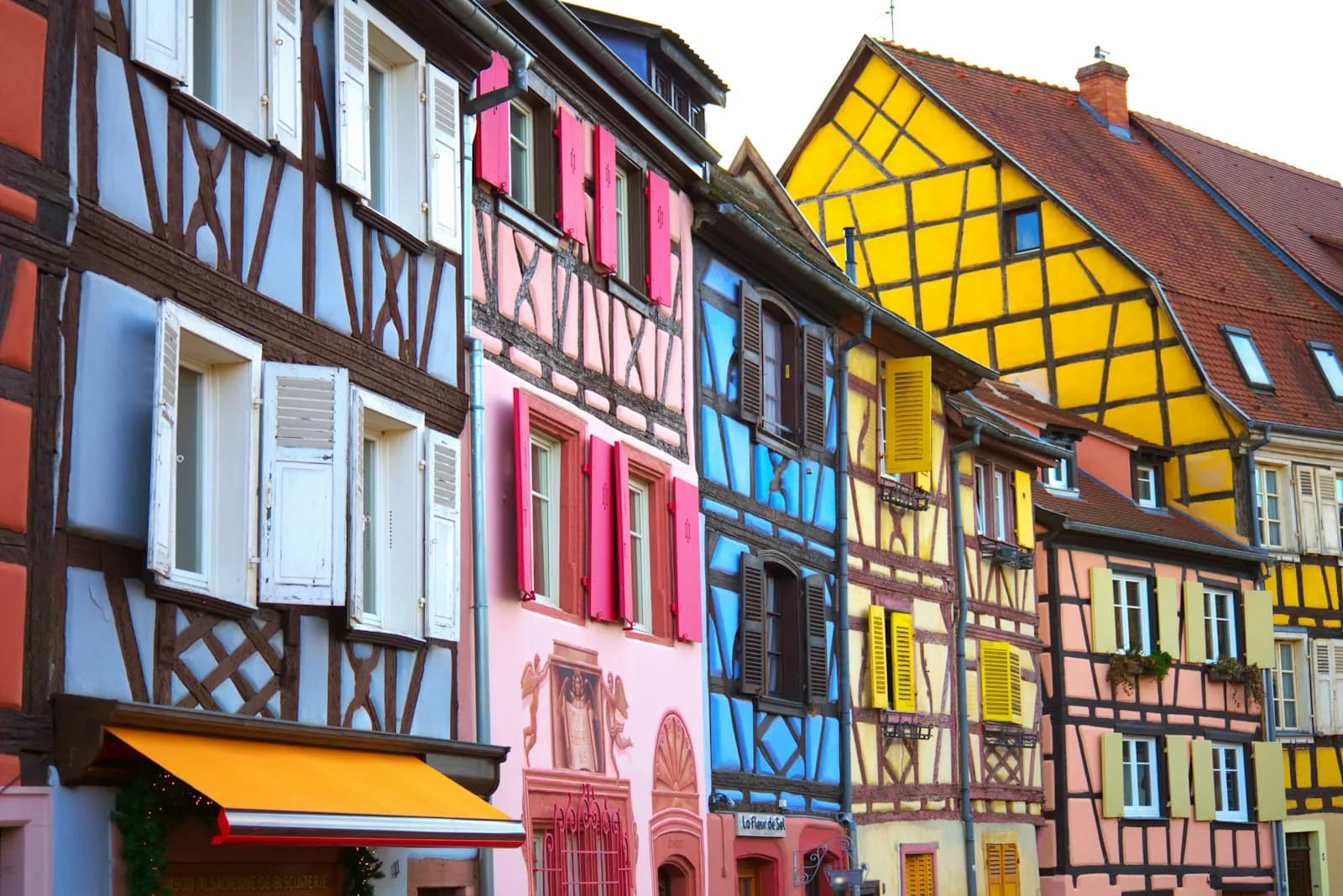
The Alsace Wine Route and Colmar: what to see
The Alsace Wine Route (Route des Vins d'Alsace) is a roughly 170 km scenic road running from Marlenheim in the north to Thann in the south, winding through around 120 wine villages along the foot of the Vosges mountains. Colmar, about 70 km south of Strasbourg, is its unofficial capital, famous for the flower-lined canals of La Petite Venise and the Unterlinden Museum. The classic highlights are the half-timbered villages of Eguisheim, Riquewihr and Kaysersberg, the hilltop Haut-Koenigsbourg castle, and the panoramic Route des Crêtes across the Vosges. From Strasbourg, Colmar plus two or three villages make an easy, unhurried day trip.
Things to do in Colmar
Compact and walkable, Colmar packs Alsace's charm into a few streets: pastel half-timbered houses, flower-lined canals and one of France's finest small museums. You can take in the essentials in half a day, which makes it the perfect anchor for a Wine Route outing (and it is at its most crowded during the Christmas markets). StrasVan drops you in the centre and handles the driving between Colmar and the surrounding villages.
- La Petite Venise (Little Venice) — the photogenic canal district around the quai de la Poissonnerie and the former tanners' quarter, best seen from the footbridges or a flat-bottomed boat.
- Unterlinden Museum — home to the celebrated Isenheim Altarpiece, a highlight of any visit to Colmar.
- Maison Pfister — an ornately decorated old merchant's house that is one of the emblems of Colmar's old town.
- Marché Couvert — Colmar's covered market, a lovely stop for Alsatian cheeses, charcuterie, produce and a quick local lunch.
- The old town on foot — a maze of cobbled lanes and half-timbered houses that reward slow, aimless wandering.
The most beautiful villages of Alsace
Alsace has four villages on the official "Les Plus Beaux Villages de France" (The Most Beautiful Villages of France) list — Eguisheim, Riquewihr, Hunawihr and Mittelbergheim — alongside a string of equally postcard-perfect neighbours such as Obernai, Bergheim and Turckheim. Most sit within a short drive of Colmar, so several can be strung together in a single day.
Eguisheim
Officially one of France's most beautiful villages and the cradle of the Alsace vineyard, laid out in concentric rings of flower-covered houses just outside Colmar — the shortest hop of all, ideal for a quick Colmar-to-Eguisheim run.
Riquewihr
A remarkably preserved medieval village still enclosed by its ramparts and watched over by the Dolder tower.
Kaysersberg
Voted France's Favourite Village in 2017, with a hilltop castle and a fortified bridge over the Weiss river.
Ribeauvillé
A lively wine town overlooked by three castles — Saint-Ulrich, Girsberg and Haut-Ribeaupierre.
Hunawihr
One of Alsace's four officially listed most beautiful villages, a tiny wine village ringed by vineyards.
Turckheim
A charming walled village where a night watchman still makes his evening round (ronde du veilleur de nuit) through the old streets in the warmer months.
Castles and nature: Haut-Koenigsbourg, the Route des Crêtes and Mont Sainte-Odile
The Wine Route isn't only villages — the Vosges foothills above it are dotted with castles and crossed by some of eastern France's finest mountain roads. A short climb from the vineyards takes you to sweeping viewpoints over the plain and, on clear days, all the way to the Black Forest. StrasVan can pair a castle visit with a village stop or a mountain drive in the same day.
Haut-Koenigsbourg castle
A restored medieval fortress perched at around 750 m, with a sweeping panorama over the Alsace plain, the Black Forest and the Vosges.
Route des Crêtes (Crests Road)
A high mountain road running along the Vosges ridgeline past summer pastures and wide-open panoramas.
Grand Ballon
The highest summit in the Vosges at 1,424 m, a landmark stop on the Route des Crêtes.
Mont Sainte-Odile
A hilltop spiritual site with a commanding view over the Alsace plain.
How many days do you need? An Alsace Wine Route itinerary
1 day (day trip from Strasbourg)
Colmar in the morning, then two or three villages in the afternoon — a classic loop is Eguisheim, Riquewihr and Kaysersberg. Colmar sits roughly in the middle of the Wine Route, so it works well as a base for heading north or south, and one day is enough for an unforgettable first taste.
2-3 days
Add Strasbourg and its cathedral, the Haut-Koenigsbourg castle and the Route des Crêtes, plus more villages such as Ribeauvillé, Obernai or Turckheim, all at a slower and more relaxed pace.
Add a day for the Black Forest
Just across the Rhine, the Black Forest makes an easy extra day trip from Strasbourg if you have time to spare and fancy a change of scenery.
The best time to visit the Alsace Wine Route
The Alsace Wine Route is beautiful year-round, but two windows stand out: May and June, when the villages overflow with flowers, and September to October, when the grape harvest fills the vineyards with colour and activity. The famous Christmas markets run from late November to late December — magical but very busy, especially in Colmar. Summer is lively and sunny but the most crowded, so it pays to start early and enjoy the villages before the coaches arrive. Whatever the season, StrasVan adapts the timing so you see the route at its best.
Why explore Alsace with a private driver?
Colmar is only about 45 minutes from Strasbourg, but the magic of Alsace is spread across small wine villages in the Vosges foothills — and most of them have no train station. A private driver turns a single stop into a full day of discovery.
The villages the train cannot reach
Eguisheim, Riquewihr, Kaysersberg, Ribeauville and Turckheim are among the most beautiful villages in France. They sit off the rail network — but your driver links them one after another, door-to-door.
Wine tastings, no one has to drive
The Alsace Wine Route is lined with family estates pouring Riesling, Gewurztraminer and Pinot. Your driver waits while you taste, so the whole group can enjoy the day with no designated driver.
Your group, your pace
Up to 8 passengers in one van, or a saloon car for two. You choose the villages, the stops and the timing — no fixed tour schedule and no crowded coach. Just your day, the way you want it.
Your Colmar & Wine Route day
Your driver picks you up at your hotel or address in Strasbourg and heads south on the A35. In about 45 minutes you reach Colmar, the capital of Alsatian wine, famous for its canals, the “Little Venice” quarter and its rows of colourful half-timbered houses.
From Colmar, the Wine Route unfolds through the vineyards. You choose the villages; here are the favourites:
- Eguisheim — concentric streets, voted a favourite village of France
- Riquewihr — a walled village straight out of a fairy tale
- Kaysersberg — riverside houses and a ruined castle above the vines
- Ribeauville & Turckheim — wineries, ramparts and quiet lanes
Between villages, stop at a family winery for a tasting. Your driver waits and drives you on when you are ready, then brings you back to Strasbourg in the evening.
How it works
Full-day hire
Get a priceYour driver is with you for the day. You decide the villages and the stops; the fixed price is confirmed before departure, with no meter.
Van or saloon car
up to 8The Mercedes V-Class carries up to 8 passengers for families and groups; the saloon car suits a couple. Comfortable seats and air conditioning throughout.
English-friendly, flexible
Tell us your interests — wine, photography, castles, food — and we suggest a route. Half-day trips are possible too.
Add the Haut-Koenigsbourg castle
A short drive above the Wine Route stands the Haut-Koenigsbourg, a fully restored medieval castle with sweeping views over the Alsace plain. It pairs perfectly with a Colmar and wine-village day.
More Alsace day trips from Strasbourg
A private driver is the easy way to see more of the region in a day.
Wine Route in depth
A full day dedicated to the vineyards and family estates, at your own pace, with tastings along the way.
Alsace Christmas Markets
In season, the famous Christmas markets of Strasbourg, Colmar and the villages, by private driver →
Europa-Park from Strasbourg
Heading to the theme park instead? See our private-driver transfer to Europa-Park →
Flying in?
EuroAirport Basel-Mulhouse is only 45 minutes from Colmar — see our airport transfers →
On a Rhine river cruise?
Ship calling at Breisach or Kehl? Private Colmar & Wine Route shore excursion →
The Alsace Vineyard: Terroir Along the Vosges Foothills
The Alsace wine region unfurls for roughly 170 kilometres along the eastern foothills of the Vosges massif, from Marlenheim in the north down to Thann in the south — the celebrated Route des Vins d'Alsace. Sheltered by the mountains, which give the region one of the driest, sunniest climates in France, some 15,500 hectares of vines ripen on a remarkable mosaic of granite, limestone, sandstone, marl and volcanic soils. Alsace is unusual in France for labelling its wines chiefly by grape variety, and its whites are bottled almost exclusively in the flûte d'Alsace — the tall, slender bottle shape legally reserved for the region's wines. StrasVan drives you the length of this route so you can taste at every stop without anyone in the group having to take the wheel.
The Seven Grapes of Alsace — Led by Riesling
Alsace grows seven traditional grape varieties and, unusually for France, names most of its wines after them. Four are considered “noble” and are the only varieties permitted in Grand Cru: Riesling, Gewurztraminer, Pinot Gris and Muscat. Whether you lean dry and mineral or aromatic and rich, your private chauffeur can shape a tasting route around the styles you love — StrasVan takes care of the driving so the whole table can sample freely.
Riesling
The king of Alsace and its most planted variety: dry, taut and mineral, with racy acidity and notes of citrus and orchard fruit that deepen with age. The benchmark grape of the region's finest Grands Crus.
Gewurztraminer
Opulent and unmistakable, with heady aromas of rose, lychee and exotic spice. A noble variety, typically full-bodied and ranging from off-dry to lusciously sweet.
Pinot Gris
Rich and rounded, showing smoky, honeyed and stone-fruit character. A noble grape spanning dry to sweet styles that pairs beautifully with white meats and mushrooms.
Muscat
The fourth noble variety: intensely grapey and floral on the nose yet remarkably dry on the palate. Alsace's classic aperitif wine.
Pinot Blanc
Soft, supple and easy-drinking, with gentle apple and floral notes. A versatile everyday white and a mainstay of Crémant blends.
Sylvaner
Light, crisp and thirst-quenching, with a fresh, faintly herbal edge. A traditional Alsace white long enjoyed with shellfish and charcuterie.
Pinot Noir
The only red grape of Alsace, producing delicate, cherry-scented reds and rosés — and, increasingly, more structured, oak-aged bottlings.
Appellations & the 51 Alsace Grands Crus
Alsace wines fall under three main appellations. AOC Alsace is the regional appellation covering the great majority of production; AOC Crémant d'Alsace is the traditional-method sparkling wine, made by the same process as Champagne; and AOC Alsace Grand Cru sits at the top of the hierarchy, recognising 51 classified terroirs — individual lieux-dits whose geology, exposure and microclimate give wines of exceptional character, drawn almost exclusively from the four noble varieties. StrasVan can chart a day among these hillside crus so you taste the very best without watching the clock or the road.
Schlossberg
Above Kientzheim and Kaysersberg, Schlossberg was the first terroir classified as Grand Cru, in 1975 — the oldest and, at around 80 hectares, the largest. Its steep granite terraces are famed for age-worthy Riesling.
Rangen de Thann
The southernmost Grand Cru and the only terroir in Alsace classified as Grand Cru in its entirety. Its steep volcanic soils yield smoky, powerful, mineral-driven wines found nowhere else in the region.
Rosacker
A renowned Grand Cru above Hunawihr, celebrated above all for its Riesling — precise, structured and built to age — grown on limestone-rich soils.
Vendanges Tardives & Sélection de Grains Nobles
Alsace's greatest sweet wines carry one of two legally protected mentions. Vendanges Tardives (VT, “late harvest”) are made from grapes picked well after normal ripeness, concentrating sugar and aroma into wines that range from off-dry to richly sweet. Sélection de Grains Nobles (SGN) goes further still: individual berries touched by noble rot (Botrytis cinerea) are hand-selected, yielding rare, honeyed dessert wines of extraordinary depth and longevity. Both are reserved for the noble varieties and made only in the finest vintages — StrasVan makes them easy to seek out along the route.
The Oldest Wine in the World, in Strasbourg
Strasbourg is home to what is widely regarded as the oldest wine in the world still kept in its barrel: a white wine from 1472, cellared at the Cave historique des Hospices civils de Strasbourg, a historic wine cellar founded in 1395 beneath the city's hospital. In more than five centuries it has been poured only three times — in 1576, 1716 and 1944, to mark the Liberation of Strasbourg. It makes a fitting place to begin a wine day: StrasVan collects you in Strasbourg and drives you straight from this living piece of history out onto the Route des Vins d'Alsace.
Which Alsace wines should I taste on the Route des Vins?
Start with the four noble varieties — Riesling, Gewurztraminer, Pinot Gris and Muscat — then compare a village-level AOC Alsace with a single-vineyard Grand Cru such as Schlossberg or Rosacker, and finish with a Crémant d'Alsace or a sweet Vendanges Tardives. StrasVan builds the route around your tastes and drives you from village to village, so everyone in your group can taste freely without anyone having to drive.
Can you really see the 1472 wine in Strasbourg?
You can visit the Cave historique des Hospices civils de Strasbourg, the cellar (founded in 1395) where the famous 1472 white is kept — though that legendary barrel has been served only three times and is not open for tasting. It makes a memorable first stop before heading into the vineyards, and StrasVan can collect you in Strasbourg, include the historic cellar, and drive you on along the Alsace Wine Route for the rest of the day.
Frequently asked questions
Everything you need to plan your Alsace day trip.
Can I book a private Alsace wine tour from Strasbourg?
Yes — a private Alsace wine tour with your own driver, door-to-door from Strasbourg: Colmar, the Wine Route villages (Eguisheim, Riquewihr, Kaysersberg, Ribeauville) and cellar tastings in one day. You choose the wineries, no one has to drive, and the price is fixed — one price for the whole van, not per person.
How far is Colmar from Strasbourg?
Colmar is about 73 km from Strasbourg, roughly 45 minutes by car on the A35. Your driver takes you door-to-door, with no station transfer.
Can you take us to the wine villages, not just Colmar?
Yes — that is the point. The train only reaches Colmar station, but the prettiest villages (Eguisheim, Riquewihr, Kaysersberg, Ribeauville, Turckheim) are off the rail network. We link them door-to-door and wait while you explore.
Can you do a one-way transfer from Strasbourg to Colmar, not just a day trip?
Yes — besides full-day tours, we run one-way and return private transfers from Strasbourg to Colmar (about 73 km, 45 min) and to the wine villages, door-to-door, fixed price. Send us your pickup, destination and time for a quote.
Which villages can we combine in one day?
You can comfortably pair Colmar with two or three villages — for example Eguisheim, Riquewihr and Ribeauville, or Kaysersberg and Riquewihr. Your driver links them door-to-door and waits while you explore.
Can we stop for wine tasting?
Absolutely. The Wine Route is lined with family wineries. Your driver stops wherever you like and waits, so no one in the group has to drive after a tasting.
How many people can come?
Up to 8 passengers in the Mercedes V-Class van, ideal for families and groups; a saloon car is perfect for a couple. Everyone stays together all day.
How much does the day trip cost?
The price is fixed and confirmed before departure, based on the day and the itinerary, with no meter. Get your exact quote on the booking page or tell us your plan.
Do you offer other Alsace day trips?
Yes — Haut-Koenigsbourg castle, the Christmas markets in season, and Europa-Park. Tell us what you would like to see and we build the day around you.
What is there to see on the Alsace Wine Route?
The Alsace Wine Route stretches about 170 km from Marlenheim to Thann through some 120 wine villages. The must-sees are Colmar and its Little Venice canals, the picture-book villages of Eguisheim, Riquewihr and Kaysersberg, and the hilltop Haut-Koenigsbourg castle, with the Vosges and the Route des Crêtes for mountain scenery. StrasVan runs private day trips along the route from Strasbourg by Mercedes V-Class van (up to 8 seats) or sedan.
How many days do you need to visit Colmar and the Alsace Wine Route?
One day is enough to see Colmar plus two or three villages as a day trip from Strasbourg, while two to three days let you add Strasbourg, the Haut-Koenigsbourg castle and the Route des Crêtes at a relaxed pace. With a private driver you can cover several villages in a single day without worrying about parking or directions. StrasVan builds the itinerary around what you most want to see.
When is the best time to visit the Alsace Wine Route?
May-June and September-October are ideal — the first for villages in full bloom, the second for the grape harvest and autumn colours. The Christmas markets (late November to late December) are magical but very crowded, and summer is sunny but the busiest of all. StrasVan can pick you up early so you reach the prettiest villages ahead of the crowds.
What are the most beautiful villages of Alsace, and is Colmar worth visiting?
Colmar is absolutely worth it for its canals, half-timbered old town and the Isenheim Altarpiece at the Unterlinden Museum. Alsace's four officially listed most beautiful villages of France are Eguisheim, Riquewihr, Hunawihr and Mittelbergheim, joined by favourites such as Kaysersberg and Ribeauvillé. StrasVan can combine Colmar with the finest villages in one door-to-door day, at a fixed price confirmed before departure.
Plan your Colmar & Wine Route day
Door-to-door, at your own pace, with a fixed price known before you go. Tell us your plan and we build the perfect Alsace day around you.